Does Sound Therapy Actually Work for Sleep? Here’s What I Found
By Dale • EO Garage •
I’ll be upfront with you, I was skeptical about sound therapy for a long time. It sounded like the kind of thing that works for people who burn incense and have a gong in their living room. Not really my world.
But after a stretch of genuinely bad sleep, I started looking at anything that might help. I tried the binaural beats thing mostly out of curiosity. And something shifted.
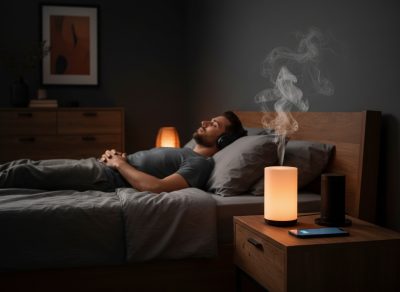
I’m not here to oversell it. What I can tell you is what I found, how it works, and how I use it now alongside essential oils as part of a wind down routine that actually holds up on hard days.
So What Is Sound Therapy, Exactly?
Sound therapy is a broad term that covers a range of audio-based techniques used to promote relaxation, focus, or sleep. For our purposes, guys who want better sleep we’re really talking about a handful of specific sound types that have a calming effect on the nervous system.
This isn’t about listening to soothing music before bed (though that doesn’t hurt). It’s about using specific frequencies and sound patterns that interact with how your brain processes and transitions between states of alertness.
The basic idea is that your brain operates at different frequencies throughout the day:
|
Beta waves (13–30 Hz) — Alert, focused, active thinking. This is where most of us spend our workday. Alpha waves (8–12 Hz) — Relaxed but awake. That calm feeling after a hot shower. Theta waves (4–8 Hz) — Drowsy, light sleep, the edge of consciousness. Delta waves (0.5–4 Hz) — Deep sleep. Where your body does most of its recovery work. |
The problem for a lot of men is that we go from Beta straight to bed and expect our brains to make that jump instantly. Sound therapy gives your brain a ramp instead of a cliff.
The 4 Types of Sleep Sounds Worth Knowing
Not all sleep sounds work the same way. Here’s a plain language breakdown of the ones that actually have something behind them:
- Binaural Beats
This is the most specific and science backed of the bunch. Binaural beats work by playing two slightly different frequencies in each ear, your brain then perceives a third tone that’s the difference between the two. That perceived tone can nudge your brainwaves toward a specific state.
For sleep, you want Delta binaural beats (under 4 Hz). Some people notice an effect quickly. Others take a few nights. You do need headphones for the full effect, though plenty of guys find that speakers still help even without the stereo separation.
Search “Delta binaural beats sleep” on YouTube and you’ll find hours of free content. Start there before you spend anything.
- Brown Noise
Brown noise is a low, deep rumble, like heavy rain, a powerful fan, or distant thunder. It’s lower and warmer than white noise, which a lot of people find harsh.
The reason brown noise helps with sleep is straightforward: it gives your brain just enough input to stop reaching for things to process. For guys whose minds run loud at night, it essentially drowns out the mental chatter without being intrusive itself.
This is the one I recommend most for guys who are brand new to sleep sounds. It works on the first night for most people, no adjustment period required.
- Nature Sounds
Rain, creek water, ocean waves, forest ambience, these work for a simple reason. They’re non-threatening, non-repetitive enough to avoid irritation, and deeply familiar to your nervous system at a primal level.
Nature sounds don’t have the brainwave-entrainment mechanism of binaural beats, but they create a calm sensory backdrop that makes it easier to relax. They’re also the easiest sell for guys who think the whole sound therapy thing sounds too clinical.
“Just put on a rain sounds video” is advice almost anyone will actually follow.
- 432hz Music
This one is a little more out there but worth mentioning. 432hz refers to music tuned to a specific frequency, slightly lower than standard concert tuning (440hz). Advocates say it has a more natural, resonant quality that promotes calm.
The science here is thinner than binaural beats or noise masking, but a lot of guys find it genuinely relaxing as a wind-down soundtrack. Think ambient, low-tempo music with a warm, open sound. Worth trying if the other options feel too clinical or monotonous.
Quick Reference: Which Sound for Which Night
| Sound Type | What It Does | Best For | Find It |
| Binaural Beats (Delta/Theta) | Guides brainwaves toward sleep state | Deep sleep, winding down fast | YouTube / Spotify |
| Brown Noise | Masks mental chatter with steady rumble | Overactive mind, staying asleep | YouTube / Calm app |
| Nature Sounds | Creates calm, familiar sensory backdrop | General relaxation, light sleepers | YouTube / free apps |
| 432hz Music | Gentle, tonal music that promotes calm | Transitioning out of a stressful day | YouTube / Spotify |
Why It Works Even Better With Essential Oils
Here’s where things get interesting. Sound therapy and essential oils target the same problem from two different directions.
The oils work through your olfactory system the scent signals your limbic brain that it’s safe to slow down. The sound works through your auditory system, giving your active mind something neutral to anchor to while your brainwaves start to shift.
Together, they create a multi sensory wind down that’s more consistent than either one alone. The scent becomes a cue. The sound becomes a cue. Over time your brain starts associating both with sleep before you even close your eyes.
|
Think of it like this: If you drink coffee every morning at the same time, your body eventually starts waking up before the coffee even kicks in just from the routine cue. The same thing happens with sleep. The oils and sound become the cue, and your body starts responding to them. |
How to Actually Get Started Tonight
You don’t need anything special. Here’s the simplest possible version:
- Open YouTube and search “brown noise 8 hours” or “Delta binaural beats sleep.”
- Set the volume low — just audible, not filling the room.
- Add 3 drops of cedarwood and 3 drops of lavender to your diffuser and start it.
- Put your phone face-down. Let things run.
That’s it. Don’t overthink the first night. The goal is just to give your nervous system a different experience than staring at a screen until you crash.
Give it three nights before you decide if it’s working. The first night your brain may not know what to do with it. By night three most guys notice they’re falling asleep faster and waking up less.
A Few Practical Notes
- Headphones work best for binaural beats but aren’t required for brown noise or nature sounds.
- Keep the volume low. You’re not trying to mask the world, just give your brain something to settle on.
- Consistency matters more than perfection. The same routine, same sounds, same oils, night after night is what builds the cue.
- Free is fine to start. YouTube has thousands of hours of every sound type on this list at no cost.
The Bottom Line
Sound therapy isn’t magic and it’s not for everyone. But for guys who lie awake with a busy mind and struggle to transition out of go-mode at night, it’s one of the most practical and underused tools out there.
Pair it with the right oils in a diffuser and a consistent routine and you’ve got something that actually works ,not because it’s trendy, but because it’s giving your brain and body the signals they need to power down.
I was skeptical too. Now it’s just part of how I end the day.